Poka-yoke means mistake-proofing: designing work to prevent an error or make it visible before it causes further harm. It gives people a better system instead of another reminder to be careful.
This post is built around excerpts from the book The Mistakes That Make Us: Cultivating a Culture of Learning and Innovation. Read more about Toyota, including stories and key lessons learned in the book.
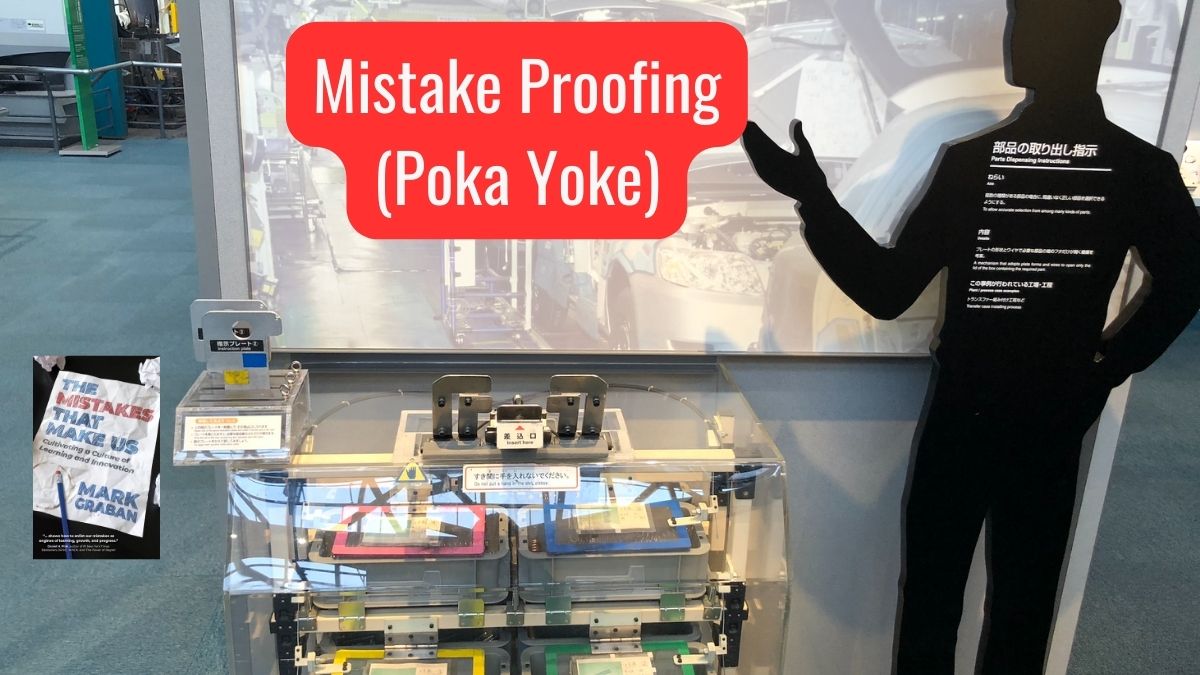
The image above is a photo that I took at the Toyota Commemorative Museum of Industry and Technology — a display about “poka-yoke,” or mistake-proofing, with an example of a device that ensures workers always grab the correct number of items as part of their assembly process.
Replace Fear with Mistake-Proofing
Fear and punishment drive people to get better at hiding mistakes when they could channel that energy into preventing them. When they can’t be hidden, repeated mistakes illustrate how punishment accomplishes nothing beyond deflecting blame from leaders.
One of my heroes, W. Edwards Deming, who also deeply influenced Toyota executives, shared what may be the most important recommendation in his famed “14 Points for Management”:
“Drive out fear, so that everyone may work effectively for the company.”[i]
Driving out fear means, in part, that everyone can feel safe to speak up about mistakes and improvement ideas, as discussed in Chapters Five and Six. Leaders can also alleviate the fear of making mistakes, to begin with, when they combine the right methods and mindsets.
Starting with mindset, as former Toyota leader Darril Wilburn says,
“It’s a leader’s responsibility to create a system in which people can be successful.”
Therefore, it’s the leader’s responsibility to drive out fear. This includes creating work systems where it’s easier to do the right thing and more difficult to make a mistake. This responsibility doesn’t fall solely on the shoulders of leaders. They also engage their team members in designing effective mistake-proofing methods.
Mistake-proofing, or “poka yoke” in Japanese, is a core method within the Toyota Production System. It’s a mindset based on the idea that people want to do good work but are imperfect. So, leaders have an obligation to help.
You might not think of Toyota as an entrepreneurial company today, but it started small in 1926 as a manufacturer of weaving looms based on patents held by founder Sakichi Toyoda. One of his key innovations was a mechanism that would automatically stop a loom when a thread broke, preventing it from cranking out more defective cloth. This innovation also led to huge productivity increases. One worker could now oversee upward of 30 to 50 machines, walking over to respond to problems when they were detected instead of having to hover over a single machine continually.
Toyota originally used the phrase “baka yoke,” which means “idiot-proofing.” Many decades ago, that term upset a Japanese factory worker who, correctly, complained that they weren’t an idiot. We should also avoid saying “fool-proofing” or “dummy-proofing,” regardless of how often we hear them spoken around us.
Professor John Grout, the former dean of the Campbell School of Business at Berry College, is an expert on mistakes, receiving some of his early education in the field from Toyota leaders. He thinks mistake-proofing should be called “slip-proofing,” as it’s easier to prevent execution errors than bad decisions (planning mistakes). One common slip is closing a file without saving it. The “Are you sure?” dialogue box tries to protect us, but as John points out, we’re likely to click “Yes” out of habit. That’s a slip on top of a slip—one that’s hard to prevent. Using software that continually autosaves your work eliminates that risk (to my benefit, as I write this book in Google Docs).
Why Mistake-Proofing Works Better Than Fear
Toyota’s approach to poka-yoke reinforces a simple but often overlooked truth: people generally want to do good work. When mistakes happen repeatedly, it’s rarely because of carelessness or lack of motivation—it’s because the system allows those mistakes to occur.
Fear-based responses don’t solve that problem. They just push errors underground, making them harder to detect and learn from. Mistake-proofing takes a different path. It respects people by acknowledging human fallibility and responds by improving processes, tools, and systems so success becomes the default.
For leaders, the lesson is clear. Driving out fear isn’t just a cultural aspiration—it’s a design challenge. When we replace blame with better systems and involve people in improving their own work, mistakes become rarer, learning becomes easier, and continuous improvement becomes sustainable.
That’s not just good management. It’s respect for people, put into practice.
Try this with one recurring mistake
Start with a mistake your team already knows about. Ask the people doing the work to show you where it becomes easy to choose the wrong item, skip a step, or lose information. What could you change so the process depends less on memory and vigilance?
- Can the process prevent the error, as autosave prevents losing unsaved work?
- If prevention is not yet practical, can it detect the error before the work moves on?
- How will you test the change and learn whether it helps without creating a new problem?
For the leadership side of this work, read about looking inward instead of blaming others.
Bring a useful conversation to your team
Start with a free preview of The Mistakes That Make Us. See how the book approaches learning, accountability, and improvement before deciding whether it is right for you.
Email registration required to receive the preview.
Prefer to listen? Choose a My Favorite Mistake episode to discuss with your team. To explore these ideas together, bring Mark to your organization or event.