
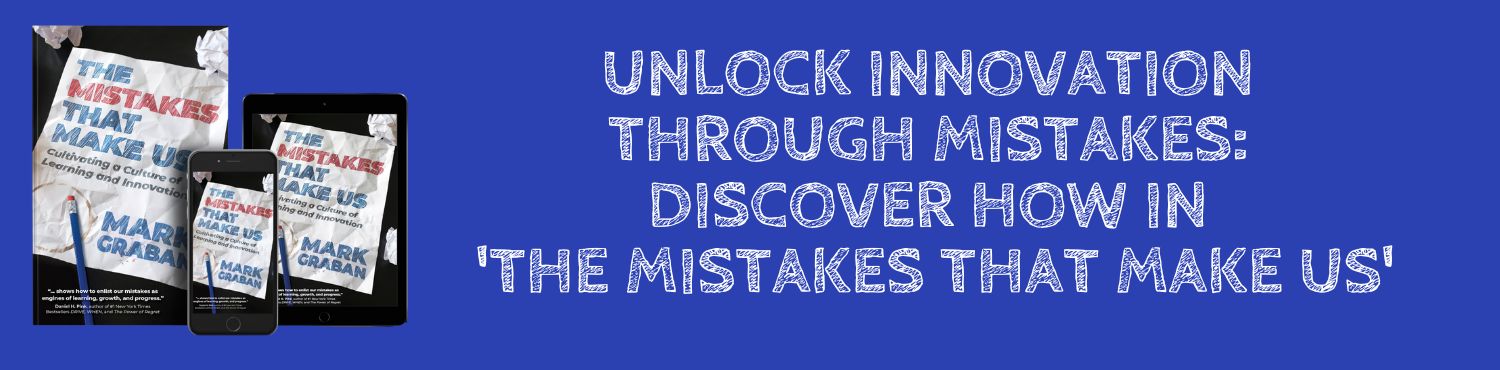
The Mistakes That Make Us is about how leaders respond when things go wrong—and how those responses shape what people do next. We can make it easier to admit a mistake, learn from it, and improve the work. Or we can make hiding it seem like the safer choice.
I wrote The Mistakes That Make Us: Cultivating a Culture of Learning and Innovation to explore those choices through stories and practical lessons. Here are the ideas I hope readers bring into their own work.
1. Learning starts with admitting what happened
We all make mistakes. Experience and good intentions do not make us immune. But admitting a mistake can feel risky, especially when we have seen someone blamed or embarrassed for doing so.
Leaders can go first: describe a mistake, explain what they learned, and show what changed. The useful part is the follow-through. An admission gives others something to learn from when it leads to reflection and action.
2. Psychological safety depends on how we respond
A positive attitude alone does not make a workplace psychologically safe. People pay attention to what happens after someone asks a question, challenges an assumption, or reports an error.
Thanking someone for speaking up, asking questions with curiosity, and helping address the problem can make the next conversation easier. Humiliation and reflexive blame can teach the opposite lesson. Psychological safety supports honest discussion; it does not remove the need for standards, responsibility, or improvement.
3. Be kind to the person and curious about the problem
Being kind does not mean pretending that a mistake caused no harm. We can acknowledge the consequences and respond with care. That includes how we talk to ourselves after making a mistake.
Instead of stopping at “Who did this?”, ask what made the mistake possible and what would help prevent it. Looking inward rather than blaming others gives leaders a place to begin.
4. Improve the system so fewer mistakes happen
Telling people to be more careful leaves much of the work unchanged. A better process can reduce dependence on memory, make the right choice easier, or detect an error before it travels farther.
The book explores this through mistake-proofing and other approaches to improvement. For one example, read about Toyota’s poka-yoke approach. We cannot prevent every mistake, but we can learn from recurring problems instead of repeatedly blaming the people who encounter them.
5. Test ideas and learn before expanding them
An improvement idea is a prediction about what might work. Testing it on a small scale lets us compare that prediction with what actually happens, make adjustments, and limit the consequences of being wrong.
Innovation does not require celebrating every bad outcome. It requires making room for thoughtful experiments and being willing to learn when the result differs from what we expected.
A conversation to have with your team
Think about a recent mistake. What happened when it was reported? What did you learn about the work? What changed afterward? Those questions can reveal more about your learning culture than a statement that says mistakes are welcome.
You do not have to change everything at once. Start with one response you can improve or one recurring problem you can work on together.
Bring a useful conversation to your team
Start with a free preview of The Mistakes That Make Us. See how the book approaches learning, accountability, and improvement before deciding whether it is right for you.
Email registration required to receive the preview.
Prefer to listen? Choose a My Favorite Mistake episode to discuss with your team. To explore these ideas together, bring Mark to your organization or event.