The Mistakes That Make Us · English
Introduction
The full Introduction to The Mistakes That Make Us: Cultivating a Culture of Learning and Innovation by Mark Graban. Free to read, no sign-up.
“What’s your favorite mistake?”
When I asked 200 successful people that question, I learned that my podcast guests possess an admirable combination of confidence and humility. They have shared stories, reflections, and lessons, including:
- The member of Congress who lost his first primary before learning from his mistake and winning in his second try
- The CEO whose savvy acquisition literally made a name for his company but saddled it with a surprising debt load that might have been a blessing in disguise
- The retired Japanese Toyota executive who wasn’t fired for a mistake that messed up the paint on 100 cars, and the American leader who had the same experience decades later in Kentucky
- The aide whose loose lips led to a spicy quote in USA Today but who, thankfully, worked for a U.S. Representative who focused on learning over punishment
- The distiller who over-aged 100 barrels of expensive whiskey but worked for a founder who realized mistakes happen when you’re innovating
- The shark whose mistake almost put his company underwater for good . . .
Wait, a shark? That’s not a typo. I’ll explain it soon.
Why would people admit mistakes like these in a public forum? They understand how reacting kindly to mistakes can lead to growth and progress. They celebrate the progress and growth that results from mistakes when we react to them in constructive ways. My podcast and book are neither a pity party nor a shaming session. They are places to remember that we all make mistakes and to celebrate the learning and vulnerability that set a powerful example for others.
When people start a story with “I’m going to be vulnerable here,” we often brace ourselves to hear something personal, if not embarrassing. Admitting a workplace mistake feels vulnerable because it exposes us to the risk of professional harm or loss—which could include being marginalized, demoted, or fired.
Guests on My Favorite Mistake admit and own their mistakes instead of blaming others for any misfortune. And they felt safe enough to do so. Sadly, many people feel pressured to protect themselves by keeping quiet about mistakes.
Speaking up isn’t a matter of character or courage—it’s driven by culture. People feel safe to share when their leaders and colleagues treat them with respect. Instead of asking people to be brave, leaders must create conditions where people can feel safe.
The most powerful question one can ask after a mistake is, “What did we learn?” People who know that their workplace reacts constructively to mistakes can reflect, learn, and improve—preventing mistakes from being repeated, learning how to prevent mistakes that haven’t happened yet, and proactively improving every aspect of our work to drive better results.
Positively Learning from Mistakes
Many say we learn the most from our mistakes and failures, including a certain beloved green character from a famous series of sci-fi galactic-adventure films, who said, “The greatest teacher, failure is.” A fellow author warned me against possibly running afoul of a litigious entertainment company by mentioning the series’ name. It does rhyme with, um, Car Chores.
Discussing mistakes might seem negative, but doing so helps us grow, leading to greater success. I’m positive about that. Mistakes can be turned into something positive—if we react to them the right way (being kind) and make the right adjustments (being constructive).
Often, It’s the Mistakes That Make Us Who We Are
The Mistakes That Make Us—that’s a good title for a book. But I could be wrong. Have I made a mistake? Only time will tell.
The mistakes that make us learn are ones to cherish.
The mistakes that make us upset are opportunities to reflect on being more kind.
The mistakes that make us examine our actions then help us improve.
The mistakes that make us frustrated, because we’ve made them before, can inspire us to finally take action and improve.
The mistakes that make us notice a small problem early on help us avoid big mistakes and possibly catastrophic failures.
The mistakes that make us embarrassed are, hopefully, made in a workplace that chooses kindness and learning instead of blame and punishment.
The mistakes that make us laugh brighten our day.
We can be thankful for mistakes.
How It Started
How did this book come to be? In May 2020, a public-relations person sent an email that said, “I’m writing to introduce one of the original ‘sharks’ on the hit TV show Shark Tank, the creator of the infomercial, and pioneer of the ‘As Seen on TV’ industry, Kevin Harrington, and his mentee, serial entrepreneur Mark Timm.”
The email concluded, “I hope you’ll consider an interview with Kevin and Mark on your show.” Wow! Yes! I wanted to. But Kevin and Mark, and their book about mentoring, didn’t tightly fit the theme of the podcast I have hosted since 2006 called Lean Blog Interviews.
I’ve been a student of “Lean Management,” based on the famed Toyota Production System, applying those methods and mindsets in settings including manufacturing, healthcare, and software organizations. Toyota has long cultivated a culture of preventing mistakes and learning from them. You’ll read stories in the book from Toyota people who have kept that culture alive and growing. Toyota’s not perfect, but they offer us much to love and learn.
In one of my earlier books, Practicing Lean, fifteen authors and I shared mistakes we made early in our careers. I also wanted to change my habit of writing occasional snarky blog posts that criticized mistake-makers, implying they should have known better. As book contributors, we aimed to reassure others (and remind ourselves) that we all make mistakes when learning and doing new things. I like to think I’ve mended my ways. I could be wrong.
Finding a Way to Say “Yes”
Thankfully, a voice in my head said, “Find a way to say Yes.” So, I asked the PR professionals what they thought about possible themes and titles for a new business podcast. These included “My Favorite Mistake,” where I proposed that guests tell a story about a mistake that turned out to be a great learning opportunity, one they wouldn’t have expected at the time.
Proposing this wasn’t risky. If I didn’t try, I would likely regret that more. I managed to turn a potentially lost opportunity into a big one—and was delighted when Kevin and Mark said they were happy to talk about mistakes! The podcast was born!
But one episode does not a podcast make. I assumed I could find other successful people willing to open up publicly to some random guy and his podcast listeners. I assumed guests would have compelling stories to tell. If guests wanted to share only humble-brag mistakes like “I’ve worked too hard and been too successful,” I would have chosen to scrub the podcast’s launch.
Thankfully, my assumptions turned out to be true. I found guests willing not only to share vulnerable stories but also to reveal what they learned and how they adjusted—and how the pain caused by their mistake subsided with reflection over time. That allowed us to talk about making something positive out of our mistakes—and how others have done the same.
I’ve released more than 200 episodes to date, with more to come. I haven’t tired of asking about favorite mistakes or hearing how people answer.
What Makes a Mistake a Favorite?
What’s a mistake? We’ll discuss that in Chapter One. What makes somebody decide that a mistake is a favorite? My question to guests is intentionally open-ended, and the answer is completely subjective. A favorite mistake is not necessarily the same as one’s “biggest.” Asking about people’s worst mistakes might trigger regret and sadness.
Through these conversations, I better understood what “favorite mistake” means to a wide range of people. A favorite might be one or more of the following:
- A mistake that’s important enough to stick with you
- A mistake that created a fortuitous opportunity or new direction
- A mistake we hope others can avoid
- A mistake that led to learning, including the actions required to prevent repeating the mistake
Who Planted the Seed for This Book?
After we finished recording their episode, one of my first guests asked me, “Did you start this podcast because you’re writing a book about mistakes?” My answer was a sincere “no.” I was motivated at that point by curiosity, learning, and the opportunity to meet some fantastic people.
After about a hundred episodes, as patterns emerged, I realized these interviews served as “field research.” These seeds started germinating as I considered writing a book about mistakes, but I don’t remember which guest did the planting! Back then, it didn’t seem important to remember exactly who asked. Please let me know if you’re reading this and remember asking me the question. I’m very grateful, whoever you are.
Cultivating the Culture—What’s Ahead
In this book, you’ll read about companies cultivating a culture of learning from mistakes, including global manufacturers like Toyota, software companies like KaiNexus, and, perhaps surprisingly, two small whiskey distillers. The ability to learn from mistakes isn’t a technology only the largest companies can afford. It’s something anybody can cultivate.
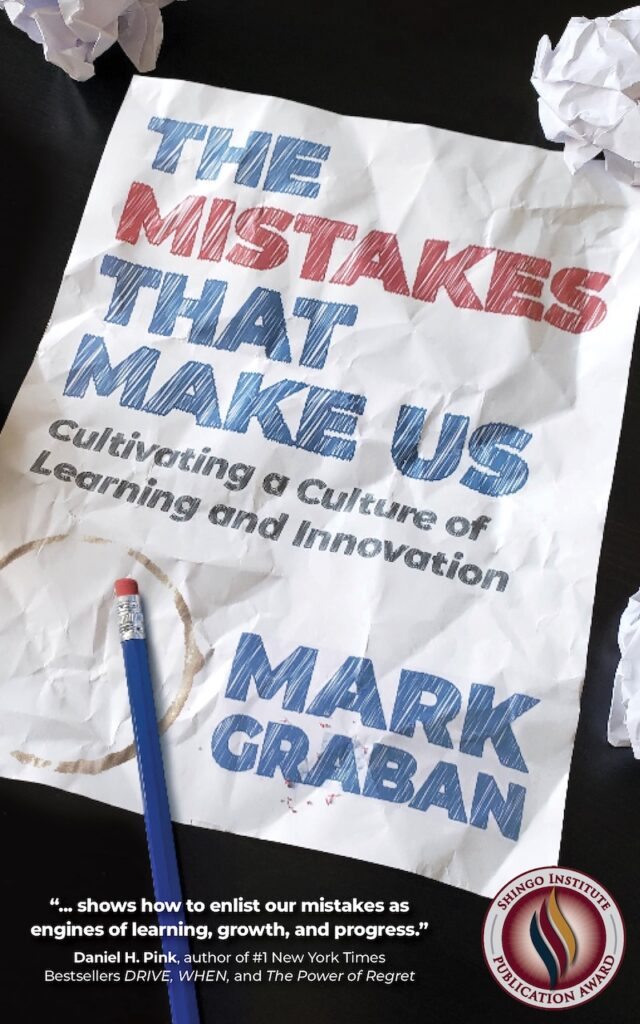
After a lot of consideration and debate, I chose the word “cultivating” to start the book’s subtitle. That word was a gift from my old friend Don Coon, a professional artist who created the book’s cover. I use the word throughout the book instead of alternatives like “building” or “creating.” To me, “building a culture” sounds too mechanical. “Creating” one sounds like a one-time event.
I don’t consider myself as having a green thumb, but we can draw parallels between a garden and our culture. The word “culture” has roots in Latin, cultus (“care”) and French, colere (“to till the ground”).
First, leaders need to declare the intent to start cultivating the culture. As we launch a startup, we can decide what to plant and where. Or sometimes, we discover that a healthy culture has sprouted up as a result of the way people act, so we then declare our intent to consciously keep the culture growing and thriving.
The second step is analyzing and preparing the soil that provides the foundation for our culture. What figurative rocks and weeds do we need to clear? Are any leaders making the soil too acidic for anything to grow? Are they willing and able to change, or do we need to change out certain leaders to ensure that our garden will survive?
Thirdly, leaders plant the seeds for a culture of learning from mistakes by modeling behaviors like admitting mistakes to themselves and then to others. As employees start feeling safe enough to follow their lead, others will plant more seeds by admitting their mistakes.
Finally, a garden requires continued food, water, fertilizer, and sunlight. Our culture is nurtured by what we do and how we act. Food and water are represented by leaders reacting kindly and constructively to mistakes. Effective problem-solving and process improvement are the fertilizer that accelerates growth. The sunlight of transparency means sharing of mistakes, lessons learned, and improvements—because it feels safe to do so.
The first part of the book focuses on actions that start on an individual level: thinking positively about mistakes (Chapter One), admitting mistakes (Chapter Two), and being kind to yourself and others (Chapter Three). Next, we look at methods for proactively preventing mistakes (Chapter Four) while cultivating higher psychological safety levels required for employees to feel safe in speaking up (Chapter Five). The final part of the book discusses the need for leaders to react constructively to mistakes, shifting from punishment to improvement (Chapter Six), the opportunity to iterate our way to success (Chapter Seven), and some concluding examples and thoughts about starting or continuing our cultivation efforts (Chapter Eight).
Thanks for reading. I hope you don’t decide that’s a mistake.
Keep reading
Get Chapter One free by email, or get the whole book in print, Kindle, audiobook, or as a DRM-free eBook on Leanpub.
Bringing these ideas to your organization? Mark gives keynotes and workshops for organizations around the world. Ask about a keynote or workshop or Contact Mark.